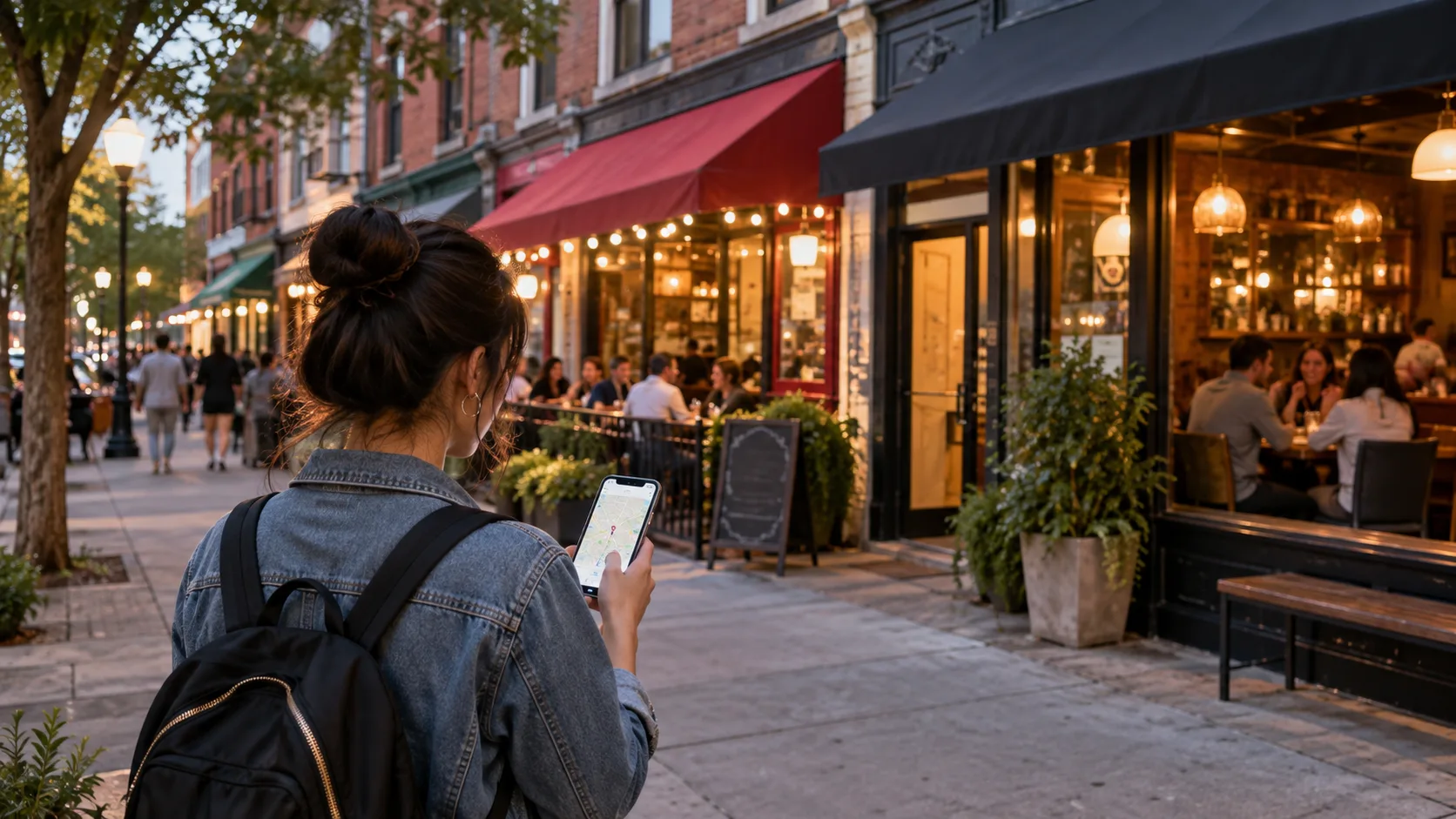
A vague search returns a vague answer
“Food near me” is a question with a missing variable. Near what, open when, at what price, and eaten where — those four unstated constraints are the difference between a result list and a decision. Search tools guess at them from device location and time of day, and they guess badly whenever you are travelling, using a virtual private network, or planning ahead for later in the evening.
Supplying the constraints yourself is usually faster than scrolling. A neighborhood or postal code, a time, a price band and a format — takeout, a table, something that survives a fifteen-minute drive — cut the list to something a person can evaluate. The sections below cover why local results go wrong, how to read a business profile and its reviews for the specific thing you need, and how to check a restaurant’s inspection record while keeping your location data under control.
Why local results go wrong
Location results can be wrong when device permissions are off, a virtual private network changes the apparent region or the map centers on an old area. Confirm the neighborhood or postal code before choosing. Distance is usually straight-line or route-based depending on the service, and “near” can widen when few businesses match. A restaurant five miles away along a fast road may be quicker than one two miles across a congested center. Check the route and arrival time, not just the pin order.
Business profiles are partly maintained by owners and partly assembled from public and user-contributed information. Holiday hours, kitchen closing times and temporary closures can lag. Open the restaurant’s official site or call its published number for a time-sensitive visit. “Open now” may refer to the building even when delivery has stopped or the dining room is closing. For a large party, accessibility need or dietary restriction, direct confirmation is worth more than a platform badge.
Reading profiles, reviews and delivery rankings
Use reviews to answer specific questions: Is takeout packed well? Is lunch faster than dinner? Does music make conversation difficult? Read recent entries across several ratings and look for recurring details. A sudden cluster of vague praise, copied phrases or reviews unrelated to the location deserves less weight. Photographs help estimate portions and layout, but menus and prices shown in old images may be obsolete. Sort mentally for the occasion rather than averaging every customer’s priorities into one score.
Delivery ranking can reflect availability, commissions, promotions and sponsored placement in addition to quality. Compare the final checkout total—including service fees, delivery charges, small-order fees and tip—with pickup. Confirm the delivery address and apartment instructions before paying. Order food that travels well when the route is long, and meet the courier promptly so hot and cold foods do not sit. Report missing seals or visibly unsafe temperatures through the service and restaurant.
Inspection records and location privacy
Local health departments often publish inspection reports, though formats and scoring systems differ. Search the agency that covers the restaurant’s address, check the inspection date and read violations and corrections rather than relying on a letter alone. Inspection data is not a real-time guarantee, but repeated failures involving temperature, handwashing or pests provide useful context. A restaurant with no platform reviews may still be well established; public records and direct information can broaden the picture.
Protect privacy when using location search. Grant precise location only when needed, review saved location history and avoid posting a real-time routine publicly. A map result or advertisement can imitate a business and substitute a fraudulent phone number, so use the verified official site for deposits or unusual payment requests. Once the meal is chosen, share only the address details necessary for delivery. Convenience should not require exposing an entire movement history.
Making the call, literally
For anything time-sensitive, a phone call still outperforms every other method. Published hours lag reality, kitchens close before dining rooms do, and a restaurant that is technically open may have a forty-minute wait it has no way to advertise. Thirty seconds on the phone also establishes whether anyone there can answer an allergy question, which is information no profile carries.
Build a short personal list rather than searching fresh each time. Three or four places that reliably work for different situations — fast and near, good enough for guests, safe for a specific dietary need — remove most of the decision cost and are far more accurate than a ranking that shifts with promotions and commissions. Update it when one of them slips. That list is a record of your own experience, which is the only local data collected specifically about what you like.